Eight Cybersecurity Questions Florida Law Firms Keep Asking
Eight Cybersecurity Questions Florida Law Firms Keep Asking
Plain answers on Microsoft 365, email fraud, ransomware, MFA, budgets, incident plans, vendors and where to start, written for partners who do not have an IT department.
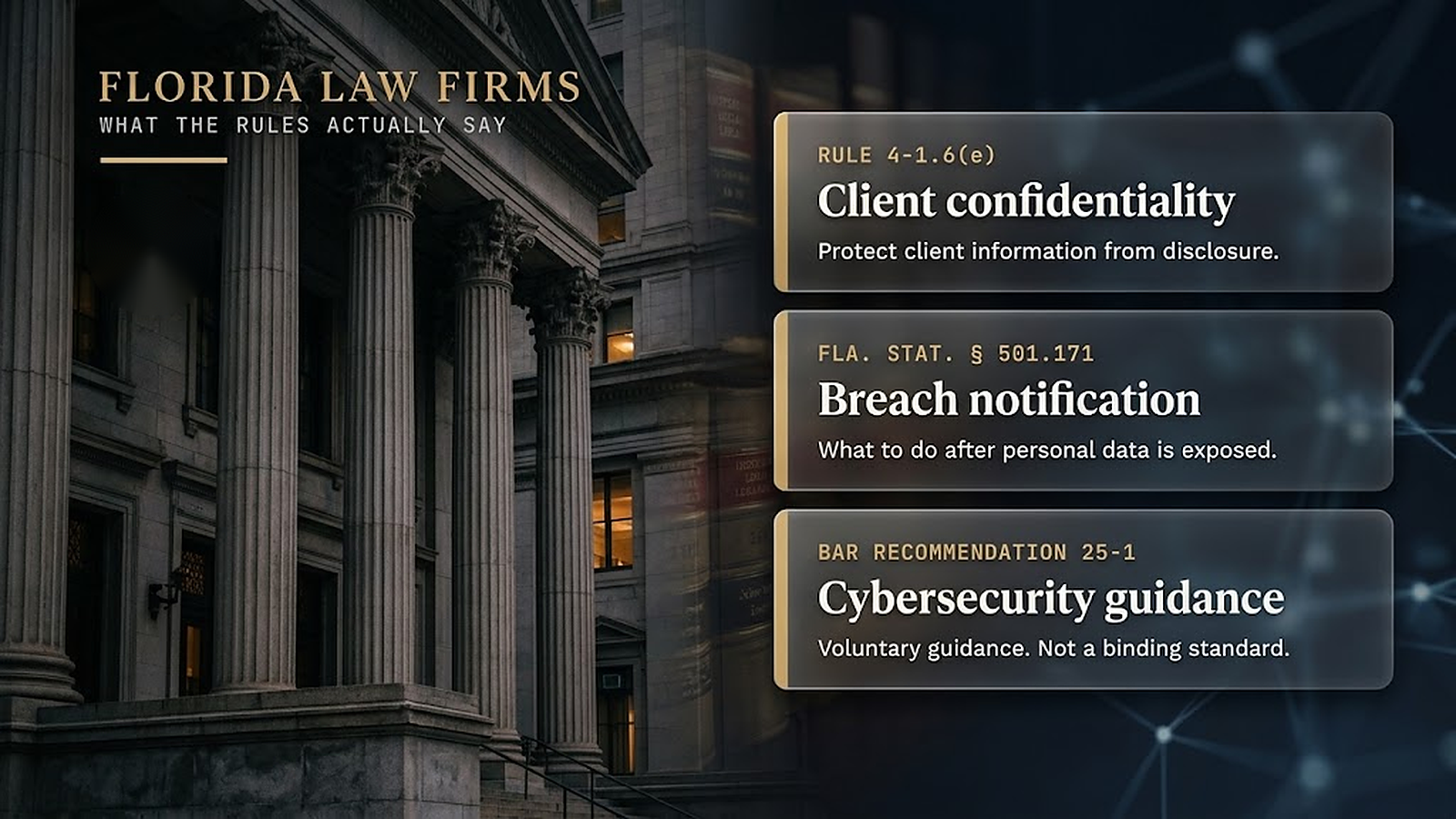
Rule 4-1.6(e) of the Rules Regulating The Florida Bar says a lawyer must make reasonable efforts to prevent the inadvertent or unauthorized disclosure of, or unauthorized access to, information relating to a client's representation. The comment to the rule explains what reasonable turns on: how sensitive the information is, how likely disclosure is without extra safeguards, and the cost and difficulty of adding them. A lawyer who made reasonable efforts is not in violation if something still goes wrong. Because the test weighs cost and difficulty alongside risk, it does not look the same for every firm. It does call for deliberate effort.
Separately, the Florida Bar's Committee on Cybersecurity and Privacy Law has issued Recommendation 25-1. It is voluntary and, by its own terms, not a directive or a standard of care. Its central ask is that firms prepare and annually maintain an incident response plan, supported by data mapping and a maturity assessment, with encryption, access controls and staff training alongside. It suggests finishing the mapping and assessment within two years and having the plan in place within three, and encourages going sooner.
Neither document is a configuration checklist. This article covers the technical side: the eight questions we hear most from solo and small Florida firms, answered the way we would answer them across a conference table. It is general information, not legal advice. Ask your own counsel how the Rules Regulating The Florida Bar and Florida law apply to your firm.
By the numbers
- $2.77 billion: reported U.S. losses to business email compromise in 2024, second only to investment fraud (FBI IC3, 21,442 complaints).
- 99.22%: reduction in account compromise risk associated with MFA in Microsoft's study of commercial accounts.
- 34%: share of surveyed attorneys who said their firm has an incident response plan, down from 42% a year earlier (ABA 2023 TechReport).
- $1.53 million: average ransomware recovery cost reported in 2025 across organizations of 100 to 5,000 employees (Sophos). Not specific to law firms.
1. Is Microsoft 365 secure out of the box?
No. Microsoft 365 is securable, but the responsibility for turning on the right protections falls to the firm or its provider, not Microsoft. The gaps we find most often are MFA applied to some accounts but not all of them, older sign-in methods such as POP3, IMAP and SMTP AUTH that skip MFA entirely, file-sharing links that are broader than the firm intended, and no alert when someone creates a hidden inbox rule, a classic sign of a hijacked mailbox.
A properly secured environment closes each gap: MFA on every account with no exceptions, older sign-in methods blocked, conditional access on risky sign-ins, sharing limited to named recipients, and alerts on suspicious rules and sign-ins. A five-attorney firm and a 25-attorney firm need the same core identity protections. What changes with size is depth, such as data governance tools, ethical walls between practice groups and management of a larger fleet of devices.
2. How does email fraud actually work against a law firm?
A typical business email compromise attack starts quietly. An attacker gets into a mailbox, often through phishing or a reused password. Then they watch. They learn how the firm communicates and how money moves, and only then do they step in, sometimes from the real compromised account and sometimes from a look-alike domain that is off by one letter. Law firms are targeted at every size because they routinely move large sums, including settlements, retainers and closing funds, and everyone in that chain is used to trusting instructions that appear to come from the attorney's office.
Controls that work operate in layers: email filtering tuned for impersonation and look-alike domains, identity monitoring that flags impossible travel or new forwarding rules, and MFA on every account so the first door stays closed. None of it replaces a callback to a known phone number before wiring money. It does make that policy far less likely to be tested.
3. What does ransomware look like inside a firm, start to finish?
Ransomware rarely announces itself when it arrives. It usually begins with phishing, a compromised remote-access tool or stolen credentials, giving the attacker one foothold on one machine. From there, attackers often spend days or weeks moving through the network and copying client files before they deploy anything. Each stage has a control that can interrupt it:
- Entry: phishing, a stolen login or exposed remote access. Interrupted by MFA and email filtering.
- Foothold: one machine is quietly under attacker control. Interrupted by endpoint detection.
- Spread and theft: lateral movement and quiet copying of client files. Interrupted by 24/7 monitoring with a person reviewing critical alerts.
- Encryption: often overnight or over a weekend. Interrupted by automated isolation.
- Recovery: rebuild, restore, notify and document. Shortened by tested offline backups.
When the encryption finally hits, the firm discovers everything at once: case files, billing records and calendars inaccessible, court deadlines suddenly at risk, a ransom note on every affected system. In a 2025 Sophos survey of organizations that had been hit, average recovery cost was $1.53 million. That sample was not limited to law firms and skewed larger than most of ours, so treat it as a sense of scale. In relative terms the picture is more equal than most solo practitioners assume. A solo practice has no IT department to notice a silent compromise and often no offline backup, so a single event can interrupt the practice's ability to serve clients for days.
4. Why is MFA considered the highest impact control?
Because it defeats the most common way attackers get in: a stolen or guessed password. A password alone, once exposed through phishing, credential stuffing or reuse from an unrelated breach, gives an attacker everything they need. MFA adds a second barrier that a remote attacker typically cannot clear. Microsoft's own research found MFA associated with a 99.22% reduction in the risk of account compromise across commercial accounts, and 98.56% in cases where credentials had already leaked. Those results assume the protection actually applies, so sign-in methods that bypass MFA need to be switched off too.
The common failure is not a firm refusing MFA. It is partial coverage. A shared mailbox, an assistant's account, a conference room login or an old admin credential gets excluded just this once and becomes the open door. The standard is simple: every account that can touch client data has MFA, with no exceptions.
5. Is meaningful protection out of reach for a firm of one to fifteen attorneys?
It is the concern we hear most, and it is understandable. Solo and small firm partners are already stretched across billable work, client development and running the business. But the premise that real protection requires an in-house security team is outdated. At this size, building one would be impractical and unnecessary. What works is a managed security model built around the risk profile of a small legal practice, not a generic small-business IT package:
- 24/7 monitoring on every endpoint, with a person reviewing critical alerts, so a threat detected at 2 a.m. on a Saturday does not wait for Monday.
- Enforced MFA and identity protection across every account.
- Email filtering tuned for the impersonation tactics aimed at law firms.
- DNS filtering that blocks connections to known malicious sites before a click becomes a compromise.
- Zero trust remote access for attorneys working from home or the courthouse, in place of a traditional VPN.
None of this requires hiring anyone. Delivered as a per-user monthly service, the cost is also predictable, instead of a large unplanned expense after something has already gone wrong. And it works alongside the firm's existing IT provider rather than replacing it.
6. What separates an incident response plan on paper from one that works?
One thing: has anyone rehearsed it? A plan in a drawer, unread by the people who would have to run it under pressure, is barely better than no plan. In the ABA's 2023 survey, only 34% of attorneys said their firm had one. A plan that works names real people by role, not the IT team: who decides to take systems offline, who calls the cybersecurity provider, who calls outside counsel, and who drafts client communications. It keeps current contact details for the firm's providers, cyber insurance carrier and breach counsel, and it plans for a backup communication channel, since email may be part of the compromise.
Testing does not require an elaborate simulation. For a firm of five to thirty attorneys, a tabletop exercise once or twice a year, an hour or two, is enough. Leadership and the security provider talk through a realistic scenario out loud: a ransom note on Monday morning, or a partner's account sending wire instructions no one recognizes. The gaps show up while the stakes are still hypothetical.
Notification timing depends on the facts, including whether a firm is treated as the covered entity or as a third-party agent holding a client's data. Under Florida's breach notification statute (section 501.171), notice to affected individuals is due as expeditiously as practicable and generally no later than 30 days after a determination of a breach or reason to believe one occurred, with limited exceptions. A 15-day extension may be available if written good cause is given to the Department of Legal Affairs within that 30 days. Breaches affecting 500 or more Floridians also require notice to the Department within 30 days. A third-party agent must notify the covered entity within 10 days. Client contracts often set shorter deadlines. Your counsel decides which of these applies to your firm.
7. How should a firm vet vendors that touch client data?
Before onboarding a practice management platform, an e-discovery tool or a document review contractor, get clear answers to a short set of questions. Does the vendor encrypt data at rest and in transit? Does it support MFA on every account that can reach the firm's data, and will the firm actually enforce it? Where is the data hosted, and does the vendor's own subcontractor chain add hops the firm has not considered? How quickly must the vendor tell the firm if something goes wrong on its end? What happens to the firm's data, and how is it returned or destroyed, if the relationship ends?
A vendor's weak controls become the firm's weak point the moment client data is shared. Ongoing vendor risk management does not need a compliance department. It needs a short, repeatable checklist applied consistently. Confirm the answers in writing, ideally through the vendor's security documentation or a completed questionnaire rather than a verbal assurance. After signing, revisit the relationship at least annually, check for publicly reported incidents, and confirm that MFA and access permissions are still set the way they were on day one.
8. Where should a partner with no IT staff and a full caseload start?
Three things, in this order, because each closes off a common way real attacks happen.
- Enforce MFA on every account, no exceptions. The fastest, cheapest, highest impact step available. It also supports the kind of reasonable effort Rule 4-1.6(e) asks lawyers to make, whatever the firm's size.
- Put 24/7 monitoring behind the firm, not antivirus alone. No partner is watching the network at 11 p.m. on a Saturday, which is when attackers like to move. A security operations team, with a person reviewing critical alerts, closes that gap.
- Write a short incident response plan and walk the partnership through it once. Name real people and real contacts. It costs little, and it lets the firm respond in an organized, documented way if something happens despite good defenses.
Sources: FBI IC3 2024 Internet Crime Report, via Nacha; Microsoft Research, How effective is multifactor authentication at deterring cyberattacks?; ABA 2023 Cybersecurity TechReport; Sophos, The State of Ransomware 2025; Rule 4-1.6 and comment; Florida Statutes section 501.171; Florida Bar Committee on Cybersecurity and Privacy Law, Recommendation 25-1.
ArisGate supports firms in meeting their obligations. It does not certify compliance with any rule, statute or recommendation, and it does not guarantee outcomes. Recommendation 25-1 is voluntary and is not part of the Rules Regulating The Florida Bar. Statistics describe the populations surveyed and are not specific to any one firm.
Not sure where your firm stands?
Take the free security assessment or book a free call with an ArisGate security expert.
Take the free security assessmentBook a free call